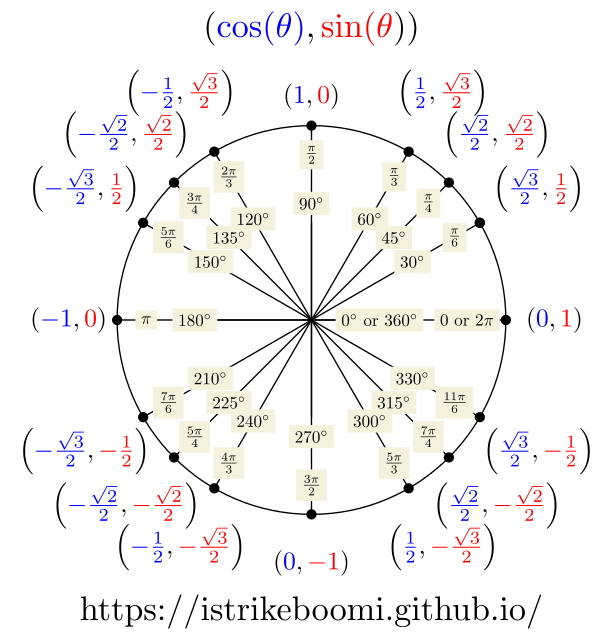
The Unit circle is a circle with the radius of $1$
The unit circle is useful because it can give us the value of trig functions at special angles
Why Trig?
If the radius of the circle is 1, we can create a line from the origin to anywhere on the circle
This line's length is 1 (becuase it is the radius)
From there we can create a triangle using the $x$ and $y$ axis as adjacent and opposite sides respectively
The radius line we drew is some angle from the line between the origin and $(1,0)$
Since we have an angle, we can use sine and cosine to get the $x$ and $y$ values
$$\begin{align} \cos(\theta) &= \frac{x}{1} = x\\ \sin(\theta) &= \frac{y}{1} = y\\ \end{align}$$
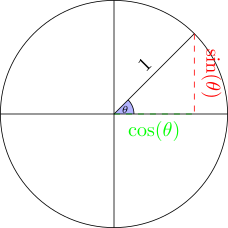
Using our normal definition for sine and cosine, the max angle we could input would be $0 < \theta < 90$
But now with the unit circle, we can extend their domain to all real numbers (by looping over the circle past $2\pi$)
We do this by making bigger angles
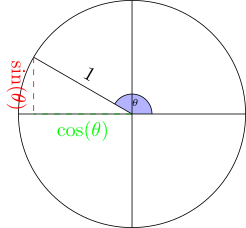
Notice how this can mean sine and cosine can have negative values
We will go into more detail when we start graphing trig functions
Tricks To Memorizing
In pre-calc and calculus, you will need to remember the values on the unit circle, because they give nice outputs
The first trick is that every number will be in the form
$$\begin{align} \pm \frac{\sqrt{n}}{2} \end{align}$$
Where $n = 1,2,3,4$
Another trick to is recognize the signs (positive or negative) of the x and y values
First Quadrant: + +
Second Quadrant: - +
Third Quadrant: - -
Fourth Quadrant: + -
To memorize the angles, just recognize every angle (in radians) is a multiple of $\pi/6$ from $0\pi/6$ to $12\pi/6$, it's just written in it's simplified form
$$\begin{align} \frac{0\pi}{6} &= 0 \\ \frac{1\pi}{6} &= \frac{\pi}{6} \\ \frac{2\pi}{6} &= \frac{\pi}{3} \\ \frac{3\pi}{6} &= \frac{\pi}{2} \\ \frac{4\pi}{6} &= \frac{2\pi}{3} \\ \frac{5\pi}{6} &= \frac{5\pi}{6} \\ \frac{6\pi}{6} &= \pi \\ \frac{7\pi}{6} &= \frac{7\pi}{6} \\ \frac{8\pi}{6} &= \frac{4\pi}{3} \\ \frac{9\pi}{6} &= \frac{3\pi}{2} \\ \frac{10\pi}{6} &= \frac{5\pi}{3} \\ \frac{11\pi}{6} &= \frac{11\pi}{6} \\ \frac{12\pi}{6} &= 2\pi \\ \end{align}$$